

Wholesale on Shopify: Pricing, Gating and Setup in 2026

Published
October 25, 2026

We build Shopify stores that sell to trade and retail from one place, so here's the version we'd give you on a call. Selling wholesale on Shopify is mostly one decision made five different ways: who sees which price. Shopify's native B2B tools handle company accounts, per-buyer catalogs and payment terms on every plan except Starter and Retail. The hard part isn't setup. It's choosing a pricing-visibility model that doesn't quietly cost you retail sales.
The five models, and who each one suits:
Yes, and for most brands you should.
This is the question behind most "wholesale on Shopify" searches, and it's telling that one of the strongest results for the term right now is a Reddit thread rather than a proper guide. Merchants are asking each other because the documentation answers how and nobody answers whether.
One store is the right default for three reasons. Your inventory stays in one place, so a trade order and a retail order draw down the same stock without a sync job in between. Your product data has one home, so a description fix happens once. And your retail SEO keeps working, because the pages that rank are the same pages trade buyers land on.
The case for a second store is narrower than it looks. It's worth it when your trade catalog barely overlaps your retail one, when the two sides have genuinely separate teams and reporting, or when your wholesale volume is large enough that the buying experience needs to be built around purchase orders rather than browsing. Short of that, running two stores means paying twice to maintain the same catalog.
Yes. Native B2B catalogs show different prices to logged-in company accounts, and a range of apps will hide prices or the add-to-cart button from everyone who isn't approved.
The more useful question is whether you should, and that's where most advice stops. Hiding a price has a cost that app listings don't mention: a product page with no price competes as a content page rather than a shopping result. Google's Product structured data is built around offer and price data, so if you strip the price from a page you should expect it to behave differently in search. Check your own Search Console against a handful of gated products before you apply it catalog-wide.
That trade-off is survivable. It's just not free, and it should be a decision rather than a default someone picked during setup.
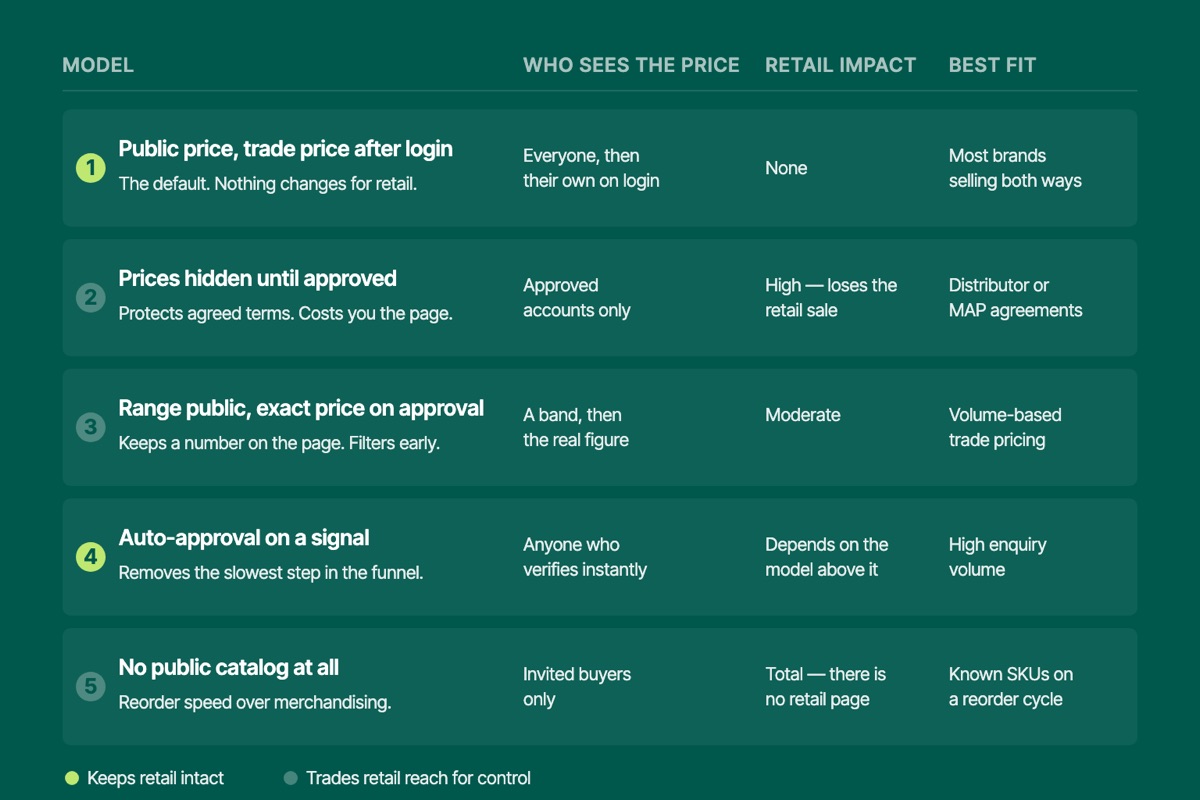
Everyone sees your retail price. Approved buyers log in and see theirs.
This is the right starting point for almost any brand that sells both ways. Nothing changes for retail customers or for search. The friction is small and lands on the people most motivated to push through it.
The honest downside: a trade buyer who arrives from Google sees a price that isn't theirs, and a few will leave before realising there's a login. A visible "Trade pricing available — log in" line on the product page fixes most of that, and costs you nothing.
Nobody sees a price without an approved account.
Choose this when your agreed terms genuinely can't be public — a distributor agreement, a minimum advertised price arrangement, a market where competitors shop your rates daily. Those are real constraints and this model exists for them.
Be clear about what you're paying for it. You lose the retail sale on every gated product, you lose the price signal on those pages in search, and you add an approval step between interest and purchase. If only part of your catalog carries the constraint, gate only that part.
Show a band. Confirm the number after approval.
This keeps a price on the page and sets expectations before anyone applies, which filters out buyers who were never going to fit your minimums. It suits brands whose trade pricing varies by volume rather than by a fixed discount, where a single number would be misleading anyway.
Approve the account automatically when something verifiable checks out — a business email domain, a tax ID, a resale certificate on file.
The reason to do this is speed. A buyer who applies on Tuesday and gets access on Friday has had three days to order from someone else. Manual review is usually the slowest step in a wholesale funnel and often the least considered.
The risk is approving someone you'd have declined. Treat auto-approval as a tier rather than a gate: auto-approve into standard trade pricing, and keep a human in the loop for the deeper discounts.
A quick-order form or buyer portal, with no browsable storefront behind it.
This fits operations where buyers reorder known SKUs on a cycle and nobody is discovering anything. Speed to reorder matters more than merchandising. If your trade buyers already work from a spreadsheet or a PDF line sheet, this is the model that replaces it.
It's the wrong model if any part of your wholesale growth depends on new buyers finding you.

Store-specific, and you can measure it rather than guess.
Before you gate anything catalog-wide, take a representative group of products and look at what they currently earn from retail traffic — direct sales and assisted revenue both. That number is what you're putting at risk. Then gate a subset, hold the rest as a control, and give it a full purchasing cycle before reading the result.
Most brands who do this find the answer is "gate some of it." The constraint that justified hiding prices usually applies to one supplier relationship or one product family, not the whole catalog. Gating everything because of one agreement is the expensive version of a reasonable decision.
If you'd rather not run that analysis yourself, our free CRO audit covers exactly this kind of question — what a change to your product pages is likely to cost before you make it.
If you want the broader version of this thinking, our Shopify conversion rate optimization guide covers where stores lose conversions more generally.
Fewer than most people assume. Shopify's own documentation confirms B2B is available on Basic, Grow, Advanced and Plus, and not on Starter or Retail, with the feature set varying by plan.
That means the gating models above are reachable without an enterprise contract. What Plus adds is scale — more catalogs, a dedicated B2B storefront, deeper checkout control. We break the plan tiers and the native-versus-app question down properly in Shopify B2B Explained, so this post won't repeat it.
Verify the current feature split on Shopify's page before you commit a budget. It has moved more than once.
We've shipped 150+ projects, and on the eCommerce side the wholesale conversation comes up constantly. We start by asking which constraint is actually forcing the gate, because the answer usually narrows the job. A single distributor agreement is a product-family problem. A competitor-pricing worry is often a positioning problem that gating won't fix. Neither needs the whole catalog hidden.
Then we model the retail revenue at risk before changing anything, so the decision is made on a number rather than a feeling. Across 150+ projects delivered and a 5.0 rating from 200+ reviews, the pattern that holds is that the merchants happiest with their wholesale setup a year later are the ones who gated the least they could get away with.
See how we approach eCommerce builds generally.
Yes, and it's the right default for most brands. One store means one inventory pool, one set of product data and no sync between the two sides. A second store earns its cost when the catalogs barely overlap, the teams are separate, or trade volume demands a purchase-order-driven buying experience.
Yes, through native B2B catalogs for logged-in company accounts or through apps that hide prices and add-to-cart from unapproved visitors. The question worth asking first is what it costs: a page with no price competes as content rather than as a shopping result, so gate deliberately rather than catalog-wide.
No. Shopify's documentation lists B2B as available on Basic, Grow, Advanced and Plus, excluding Starter and Retail. Plus adds scale — more catalogs, a dedicated B2B storefront, deeper checkout control — rather than being the thing that makes wholesale possible.
Decide the pricing-visibility model first, because it determines everything else. Then create company accounts for your buyers, attach a catalog with their pricing, set payment terms and order minimums, and define how an account gets approved. Setup is the short part; the model is the decision.
Only you can answer that, and it comes down to whether a real agreement constrains you. If a distributor contract or a minimum advertised price arrangement applies, gate the products it covers. If the worry is competitors seeing your rates, weigh that against the retail revenue those pages currently earn.
Make them wait. Manual approval is usually the slowest step between interest and a first order, and a buyer who applies and hears nothing for several days has had time to order elsewhere. Auto-approving a standard trade tier on a verifiable signal removes most of that delay.
Working out how to open a trade channel without damaging the retail side? We'll model what's actually at risk before anything gets gated, and tell you plainly if the answer is to leave your pricing public. Talk to us about your store.
18 Meriden Grove Bolton BL6 4RQ


C-Block, Citi Housing Jhelum, 49600


