

How to Increase Average Order Value Without Losing Money

Published
October 29, 2026


Most advice on how to increase average order value is a list of tactics with no arithmetic attached. Bundle things. Add an upsell. Set a free-shipping threshold. Each one is presented as a free win, and none of them are. Every tactic that raises average order value also moves your margin, your conversion rate, or both — and at least one of them loses money at the settings most Shopify stores use by default.
This guide does the maths instead: the break-even formula for a free-shipping threshold, the one upsell placement that cannot cost you conversions, the margin test for bundles, and when raising average order value is the wrong objective entirely.
There is no useful cross-industry benchmark, and the spread in the data is the proof. Littledata's 2026 Shopify benchmarks, drawn from 436 stores in October 2026, put the median average order value at $110. But the bottom 10% of stores sit at $45 and the top 10% at $590 — a thirteenfold range inside the same metric on the same platform.
A furniture store and a supplements store can both be excellent businesses at opposite ends of that range, so "is $85 good?" is unanswerable. The number that is answerable is this one:
Contribution margin per order — what is left after cost of goods, payment fees, shipping and fulfilment on a single order.
Judge every tactic below against that. A store that lifts average order value from $80 to $100 while absorbing $9 of shipping it used to charge for has raised the headline metric and reduced the money it keeps — and that is invisible if you only watch AOV.
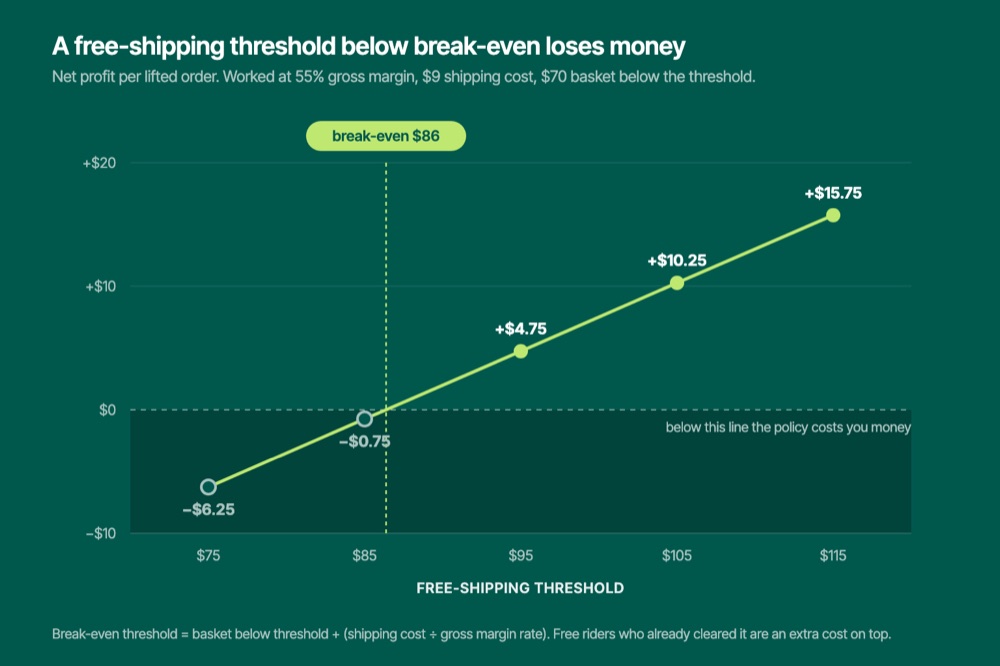
A free-shipping threshold is the most common way to increase AOV in ecommerce, and the most commonly mis-set. The usual advice is to set it slightly above your average order value. That is the one rule that reliably guarantees a loss.
When a customer who would have spent S lifts their basket to threshold T, you gain gross profit on the difference and give up the shipping you used to charge. With gross margin rate m and shipping cost C, the order only improves if:
m × (T − S) > C
Rearranged, that gives you the lowest threshold that does not lose money on the lift:
T = S + C ÷ m
Put real numbers in. A store with a 55% gross margin, $9 average shipping cost, and a $70 average basket among orders that currently fall below the threshold:
So a $75 threshold is a loss. The customer adds $5, earning $2.75 in gross profit, and you absorb $9 of shipping — a net loss of $6.25 on every order the policy "worked" on. A $95 threshold earns $4.75. The threshold has to clear your basket by shipping cost grossed up by margin, not by a round number that looks tidy.
Then the cost nobody models: customers who were already going to clear the threshold. They now get free shipping on an order they would have placed anyway — pure margin loss, no incremental revenue. Above, each costs $9 while each lifted order earns $4.75, so you can afford roughly one free rider for every two orders you lift. If most of your revenue already sits above your threshold, the policy is under water however good the lift looks.
Two assumptions to check against your own numbers: it treats your current shipping charge as roughly covering your shipping cost, and uses gross margin before fulfilment labour. If you already subsidise shipping, the free-rider cost is smaller; if you pick and pack by hand, the real break-even is higher.
The fix is not to abandon the threshold but to set it from your contribution margin, then show progress toward it — a slide-in cart with a progress bar, exactly what we built into the Furniqo storefront, turns a hidden rule into an active prompt.
Not sure where your own break-even sits? A free CRO audit includes your real threshold maths against your margin and shipping data, not a generic benchmark.
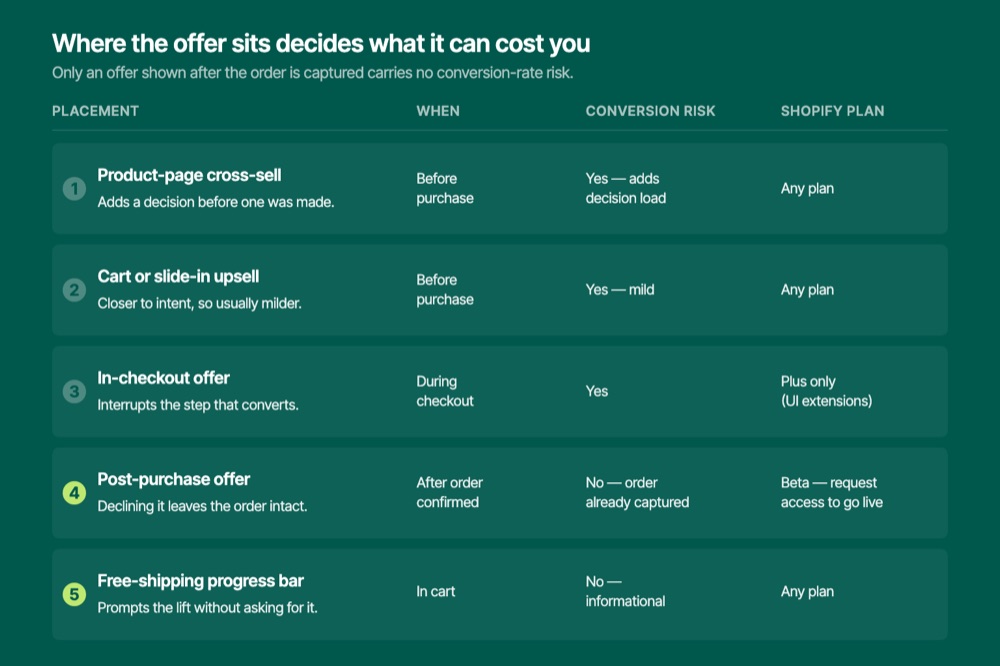
This is the distinction that decides whether raising average order value costs you orders.
Anything shown before the purchase is committed can reduce conversion. A product-page cross-sell or cart upsell adds a decision to a journey where the customer had already decided. Sometimes it pays for itself; sometimes it introduces the choice paralysis that was suppressing conversion in the first place — the problem we designed out of Loafy, where simplifying the choice lifted add-to-cart by 47%.
Anything shown after the order is confirmed cannot reduce it. A post-purchase offer appears once payment is captured; if the customer declines, the original order stays intact. It is the only placement with genuinely asymmetric risk, and the first place to look.
Two platform constraints matter here, and most tactic lists skip both:
So the sequence that respects both risk and platform: post-purchase slot first, then the cart, then the product page — treating every pre-purchase placement as an experiment with a conversion-rate guardrail, not a permanent fixture.
Bundles raise average order value by definition, since you combined two line items into one. Whether they raise profit is a separate question, and it comes down to one check:
Is the discount smaller than the margin on the units you added?
A three-pack at 15% off works if the second and third units carry enough margin to absorb the discount across all three. On a 55% gross margin, comfortably. On a 25% margin — common in electronics and anything with heavy inbound freight — that same 15% hands away more than half of what you make, and the bundle still looks like a win on the AOV dashboard.
Three rules that hold across the stores we audit:
Tiered discounts ("spend $150, save 10%") carry the same free-rider problem as the shipping threshold. Every customer who would have crossed the tier anyway now crosses it at a discount.
Sometimes the honest answer is that average order value is not your constraint, and working on it will waste a quarter.
We treat average order value as an outcome of merchandising and margin design, not a dial to turn. That means starting from contribution margin per order, deciding what the store can afford to give away, and only then choosing placements — which is why the work usually begins at the cart and the post-purchase slot, not a plugin that bolts offers onto every product page.
On Nutradora, a supplements store, that approach produced a 21% increase in average order value alongside a 43% lift in conversion rate and 35% more returning customers — the three moving together, rather than one bought at the expense of another. On Loafy, simplifying an overwhelming catalogue lifted add-to-cart by 47% and cut bounce by 24%.
Across 150+ projects we have held a 98% client satisfaction rate and a 5.0 rating from 200+ reviews. Our conversion rate optimization work on Shopify always starts in the same place: find the number actually constraining the business, then build for that one.
If you want that analysis on your own store, a free CRO audit will tell you whether average order value is your real constraint before you spend a quarter on it.
There is no meaningful cross-industry figure. Littledata's October 2026 benchmark across 436 Shopify stores puts the median at $110, but the bottom 10% sit at $45 and the top 10% at $590. Judge your own number against your contribution margin per order and your acquisition cost, not against a global median.
Divide total revenue by the number of orders in the same period. Shopify reports it under Analytics, but check whether your figure includes shipping revenue, discounts and refunds — the definition changes the number, and an inconsistent figure across months is a common source of false progress.
It means raising the average a customer spends per order, usually via upsells, cross-sells, bundles or a free-shipping threshold. The qualifier that matters: AOV can rise while profit per order falls, so read it next to contribution margin.
It works when it is set above your break-even, which is your pre-threshold average basket plus your shipping cost divided by your gross margin rate. Set below that line it reliably loses money, and it also gives free shipping to every customer who would have cleared the threshold anyway.
For risk, yes. A post-purchase offer appears after the order is captured, so declining it cannot cost you the original sale. A cart or product-page offer can depress conversion. Note that Shopify's native post-purchase checkout extensions are in beta and require requesting access for live stores, and in-checkout offers require Shopify Plus.
Merchandising changes such as a corrected threshold or a post-purchase offer give a readable signal within two to four weeks on reasonable traffic. Catalogue and bundle restructuring needs a full purchasing cycle, because the first weeks only capture customers already mid-decision.
18 Meriden Grove Bolton BL6 4RQ


C-Block, Citi Housing Jhelum, 49600


